You said yes to the arranged marriage proposal. The families agreed. The wedding happened. And now here you are — three months in, one year in, maybe five years in — realizing that something feels fundamentally off. You wonder if this is just what marriage is supposed to feel like, or if the way you met is the reason things feel so difficult.
Let’s talk honestly about arranged marriage problems that nobody mentions during the rishta process. And more importantly, how getting proper support actually changes things.
The Unique Challenges of Arranged Marriage That Everyone Pretends Don’t Exist
Arranged marriage problems are not imaginary. They are not a sign you chose wrong or that your family failed you. They are the predictable result of building intimacy with a stranger under the expectation that love will automatically follow commitment.
In love marriages, people typically move through stages — attraction, dating, engagement, then marriage. Each phase builds understanding before the next commitment. Arranged marriages flip that entirely. You commit first. Then you try to build everything else afterward, often while living together, managing family expectations, and dealing with the pressure to make it work immediately.
The disconnect between what arranged marriage is supposed to deliver and what it actually feels like creates a specific kind of stress that love marriages rarely face. You are supposed to feel grateful. You are supposed to adjust. And when you struggle, the message — spoken or unspoken — is that the problem is you.
Common Arranged Marriage Problems Nobody Talks About Openly
Let’s name what actually happens behind closed doors in many arranged marriages, especially here in Pakistan where the social script around marriage remains so rigid.
Emotional disconnect despite physical proximity. You live together. You share a bed. You might even have children together. But emotionally, you feel like roommates managing logistics rather than partners building a life. This is one of the most common arranged marriage issues — closeness without actual connection.
Communication that never moves past surface level. Conversations stay functional. Dinner plans. Bills. In-laws. But the moment you try to talk about feelings, needs, or disappointments — silence. Or worse, dismissal.
Resentment about compatibility mismatches nobody noticed before. Maybe your energy levels are completely opposite. Maybe your life goals contradict each other. Maybe your values around money, parenting, or independence clash daily. These problems in arranged marriage were always there — they just became visible after living together revealed them.
Sexual intimacy that feels mechanical or one-sided. This is rarely discussed in Pakistani marriage counseling spaces, but it is genuinely one of the most painful arranged marriage problems people privately struggle with. When emotional connection is missing, physical intimacy often becomes another source of distance rather than closeness.
Family interference that never stops. In many arranged marriages, the families who arranged the match feel ongoing ownership. Decision-making becomes a group activity. Privacy becomes negotiable. Your marriage stops being yours.
The pressure to stay regardless of happiness. “You chose this” becomes the refrain anytime you express struggle — even though choice had very little to do with how the match happened. Log kya kahenge, family izzat, and the stigma around separation keep many people trapped in arranged marriages that stopped working years ago.
Why “Just Give It Time” Rarely Fixes Arranged Marriage Problems
The standard advice for problems in arranged marriage is always the same. Give it time. Adjust more. Try harder. Lower your expectations. Be patient. As if time alone heals incompatibility or turns strangers into soulmates.
Here is what actually happens when arranged marriage problems go unaddressed. Resentment builds. Communication shrinks further. Emotional distance becomes the new normal. People start living parallel lives under the same roof — functionally married but emotionally alone.
Time does not fix these patterns. It just makes them permanent. What actually helps is structured support from someone who understands both the psychology of relationships and the specific cultural dynamics of arranged marriages in Pakistan. That is where marriage counseling makes a genuine difference.
How Marriage Counseling Actually Helps Arranged Marriages
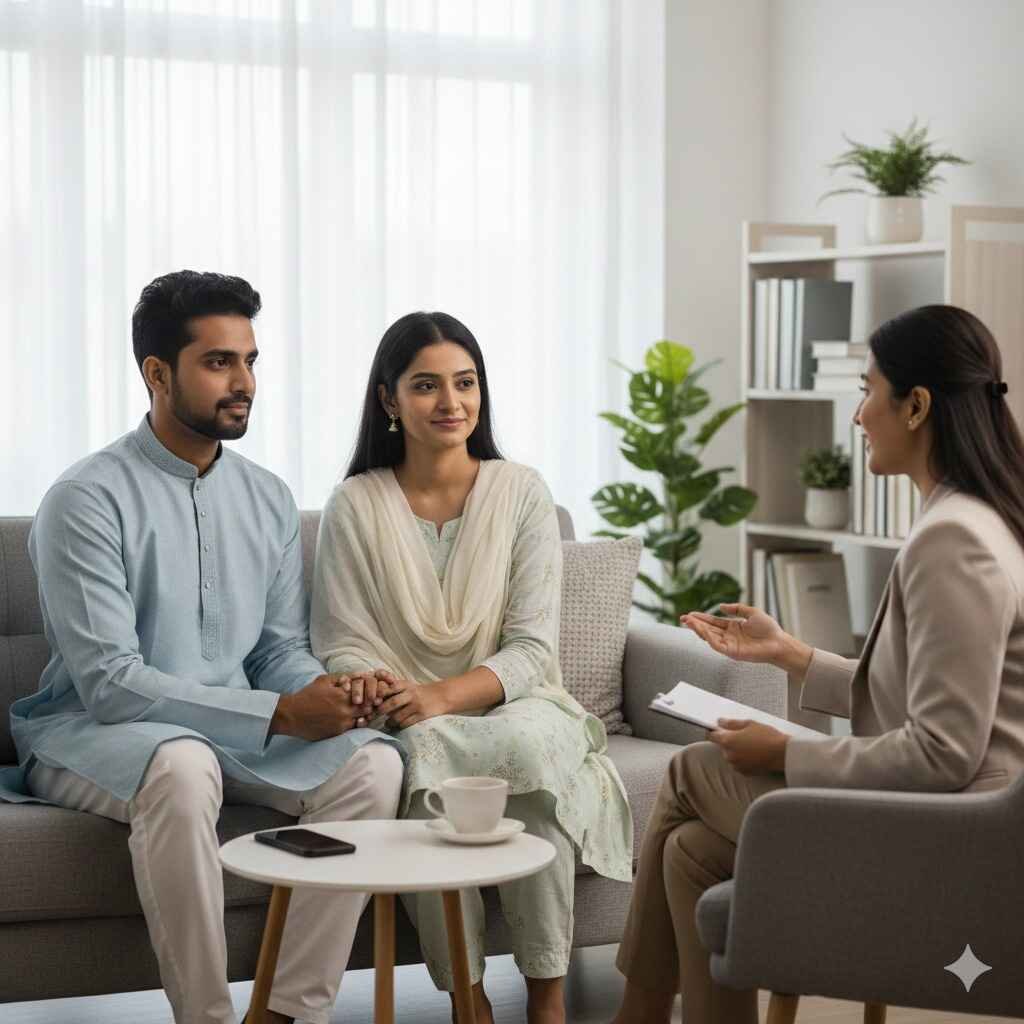
Marriage counseling for arranged marriage issues is not about blaming anyone or proving someone wrong. It is about creating space for both people to say what they actually feel without it turning into a fight or a guilt trip.
A skilled marriage counselor helps you build the communication foundation that typically develops during dating — but in your case needs to be built retroactively. They teach you how to express needs without sounding accusatory. How to listen to your partner without becoming defensive. How to identify patterns that keep you stuck rather than just blaming each other for individual moments.
Couples therapy also addresses the unspoken expectations both partners brought into the marriage. In arranged marriages, many assumptions go unchecked until they collide — assumptions about gender roles, money management, family involvement, career priorities, and emotional expression. A good marriage counselor surfaces these assumptions and helps you negotiate them consciously rather than fighting over them unconsciously.
For problems in arranged marriage involving family interference, marriage counseling provides tools for setting boundaries without creating family wars. A marriage counselor can help you understand where boundaries are reasonable and how to communicate them in culturally appropriate ways that minimize blowback while protecting your relationship.
Online counseling has made this support dramatically more accessible across Pakistan. Many people in arranged marriages cannot easily leave home for therapy appointments without raising questions or suspicion. Online counseling removes that barrier entirely — sessions happen from wherever you are, on your schedule, with complete privacy. The quality of online counseling for relationship issues is well-established now, and many of the best marriage counselors offer it specifically because they know how important accessibility is for people in difficult marriages.
What Makes Counseling Different From Talking to Family or Friends
You might wonder why you need marriage counseling when you already talk to your mother, sister, or close friend about arranged marriage problems. Here is the difference.
Family and friends care about you — but they also have agendas. Your mother might want you to stay regardless of your happiness because divorce brings shame. Your sister might project her own marriage frustrations onto your situation. Your friend might give advice based on what worked for them without understanding your specific dynamics.
A trained marriage counselor has no agenda beyond helping your relationship become healthier — whether that means staying together differently or separating respectfully. They bring expertise in relationship psychology that family conversations simply cannot provide. They see patterns you are too close to notice. They ask questions that unlock clarity rather than just offering opinions.
Couples therapy also provides accountability. When you agree to try something new in a counseling session, you have a neutral third party checking in on whether it actually happened. That structure makes change far more likely than vague promises made during arguments and forgotten by morning.
When to Consider Marriage Counseling for Your Arranged Marriage
Many people wait far too long before seeking marriage counseling for arranged marriage issues. They wait until things are completely broken. The better approach? Go early. Go when things feel stuck but not yet destroyed.
Consider couples therapy if you recognize any of these patterns. You fight about the same issues repeatedly without resolution. You feel lonely despite living with someone. Physical or emotional intimacy has disappeared. You are considering separation but feel too guilty or scared to move forward. Family pressure is suffocating your relationship. You find yourself fantasizing about a different life.
Marriage counseling helps regardless of whether both partners are equally invested. Even if your spouse initially resists, individual counseling can help you navigate your situation more clearly and decide what you genuinely want rather than what everyone else expects from you.
Finding the Right Support in Pakistan
Accessing quality marriage counseling in Pakistan has improved significantly. Major cities like Karachi, Lahore, and Islamabad now have trained professionals who understand both Western relationship psychology and Pakistani cultural realities — including the specific dynamics of arranged marriages.
Look for a marriage counselor who explicitly mentions experience with arranged marriage problems or cultural issues in Pakistani families. Generic relationship advice often misses the nuances that make your situation unique.
Online counseling platforms have also made support available beyond major cities. Quality therapists now offer online counseling that serves couples anywhere in Pakistan. This matters enormously for people in smaller cities or conservative areas where in-person therapy feels impossible.
At Better Bonds, our marriage counselors specialize in helping couples navigate arranged marriage issues with cultural sensitivity and psychological expertise. Whether you choose in-person sessions or online counseling, the support you need exists — and it genuinely works when both people engage honestly.
Your Marriage Deserves More Than Just Survival
Arranged marriage problems are not a life sentence. They are challenges with solutions — but those solutions require support, not just willpower. You do not have to figure this out alone, and you do not have to stay stuck in a pattern that stopped working years ago.
Marriage counseling is not giving up on your marriage. It is fighting for the marriage you actually want rather than just enduring the one you have. That difference matters more than anything else.
If your arranged marriage feels more like an obligation than a partnership, reaching out for couples therapy might be the most important decision you make this year. Not because your marriage is broken — but because you deserve one that actually works.
Contact better bonds today and take the first step toward stronger, healthier relationships.
